
🧠 The Science of Roughhousing:
Why Play-Fighting Is Powerful for Your Child’s Brain, Nervous System, and Confidence
@COPYRIGHT ASHLEY ANJLIEN KUMAR. ALL RIGHTS RESERVED.
Many parents hesitate when it comes to roughhousing. It can look noisy, messy, or even a little chaotic.
The most common parent concern is:"If I do that, then I'm encouraging fighting and aggressive behaviors..."
Another challenge that stops modern parents from play-fighting with their kids is that they don't want to appear "aggressive" towards their children; they face internal discomfort stemming from their own childhood, and/or discomfort based on modern parenting messages around being "gentle."
Other added layers are that, for a long time, roughhousing and play-fighting have been considered “dad-specific”. Or even that it's just kids doing it with each other, and mothers, often deemed nurturers, generally avoid this type of play.
But...What if modern developmental psychology and neuroscience tell us a very different story?
In this article, you’ll learn:
Why healthy roughhousing is not about encouraging aggression—but about building regulation, resilience, confidence, and connection.
We’ll explore:
what happens in your child’s brain and nervous system during rough play
how play-fighting can strengthen impulse control and emotional regulation
why roughhousing teaches social intelligence, boundaries, and consent
how safe physical play can shape future relationship patterns and emotional security
why mothers play an incredibly important role in this type of connection
and how to know when roughhousing is healthy vs. harmful
You may never look at play-fighting the same way again.
Let’s break it down...⤵️
1. Emotional regulation
1. What’s actually happening in the brain and body
During roughhousing, children enter a state of high physiological arousal:
heart rate increases
adrenaline rises
the brain’s emotional centers (especially those involved in excitement and threat detection) become more active
This isn’t just “getting hyper.” It’s a mild, controlled activation of the same systems involved in stress and big emotions.
What makes rough play powerful is what happens next.
In regulated play, children repeatedly shift between:
activation (excitement, intensity, competition)
deactivation (pausing, laughing, resetting, reconnecting)
At the same time, research from Dr. Sergio Pellis demonstrates that during play-fighting, children must constantly adjust, inhibit, and recalibrate their responses based on feedback from their play partner.
That means the brain is practicing:
inhibitory control (“don’t go too far”)
emotional flexibility (shifting from intense → calm → intense again)
social regulation (staying connected while activated)
Over time, these repeated cycles strengthen the connection between the limbic system (emotional brain) and the prefrontal cortex (regulation and control).
In simple terms:
👉 The child isn’t just “burning energy”
👉 They are wiring their brain to handle big feelings without becoming overwhelmed
This contributes to the development of emotional resilience.
2. Impulse control
One of the most overlooked benefits of rough-and-tumble play is that it can help improve impulse control (which we know is "in construction" through the age of brain maturity at age 25+); it requires children to practice self-restraint while emotionally activated.
Why roughhousing strengthens self-control
Impulse control is not built when a child is calm and still at a desk. In calm moments, we all as humans have more access to logical, rational decision making. But when a child is in the "yellow zone" (think "Zones of Regulation" by Leah Kuypers), they can often act without thinking. And for young kids, this is partly the journey of growing up. And other times, it's learning about the "experience" we have when feelings and sensations associate with self-control.
Self-control as a skill, is built in moments where the brain has to manage:
excitement
unpredictability
frustration
competitiveness
physical intensity
During rough play, children can receive feedback from others:
“Too hard.”
“Stop.”
“Your turn.”
“Pause.”
“That hurt.”
To keep the game going, they get to learn to:
inhibit stronger impulses
adjust force and intensity
delay reactions
recover after mistakes
Research from Dr. Pellis suggests that rough-and-tumble play contributes to development in the orbitofrontal cortex, a region of the brain heavily involved in emotional control and recognizing social consequences.
In animal and human play studies, playful fighting is rarely chaotic randomness. It involves continual self-monitoring and rapid behavioral adjustment.
Children are learning:
“Can I stay connected to another person while controlling my impulses?”
That is an executive functioning skill.
3. Social Intelligence & Boundaries
Roughhousing is deeply social.
Even though it looks physical from the outside, the child’s brain is actually processing an enormous amount of inter-relational information in real time.
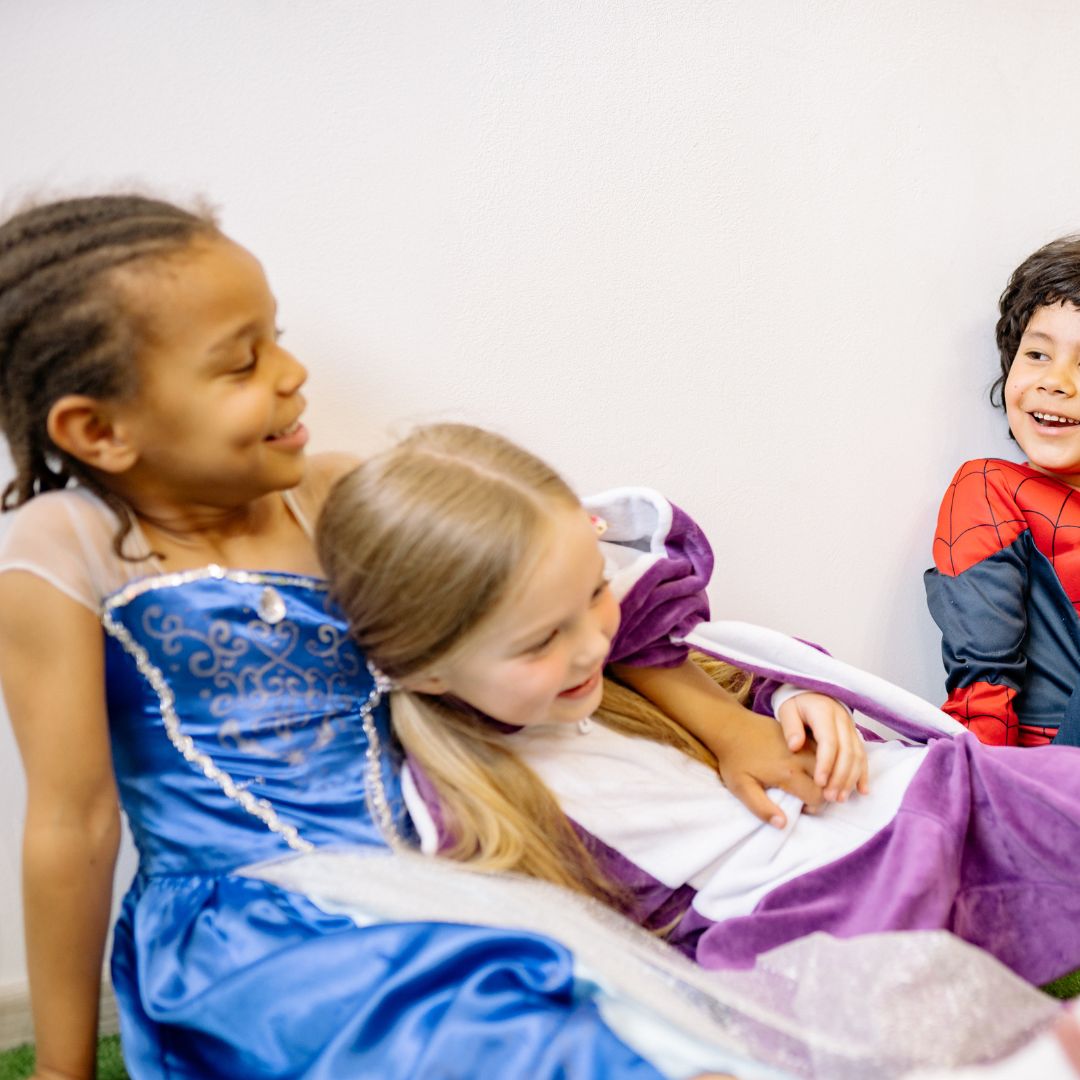
The hidden social learning:
During play-fighting, children must constantly interpret:
facial expressions
tone of voice
body positioning
intensity levels
emotional shifts in the other person
This is called social referencing—using another person’s cues to guide behavior.
Children quickly learn:
“Are they still having fun?”
“Did I go too far?”
“Should I slow down?”
That ongoing feedback loop strengthens social awareness and empathy. Research on play behavior shows that healthy roughhousing is highly cooperative beneath the surface. Players often unconsciously or intentionally self-handicap, take turns, and soften their strength to maintain connection and reciprocity.
In other words:
The goal of healthy roughhousing is not domination. The goal is mutual enjoyment and continued relationship.
This teaches children something incredibly important:
boundaries are dynamic
consent matters
relationships require responsiveness
Unlike lectures about empathy or respect, roughhousing allows children to experience these concepts physically and emotionally.
They are not just hearing:
“Respect people’s boundaries.”
They are practicing:
“How do I notice and respond to someone else’s limits in real time?”
That is advanced social learning.
4. Confidence & Resilience
Healthy roughhousing exposes children to manageable levels of uncertainty, risk, intensity, and challenge inside a safe relationship. This is important because resilience is not built through constant comfort.
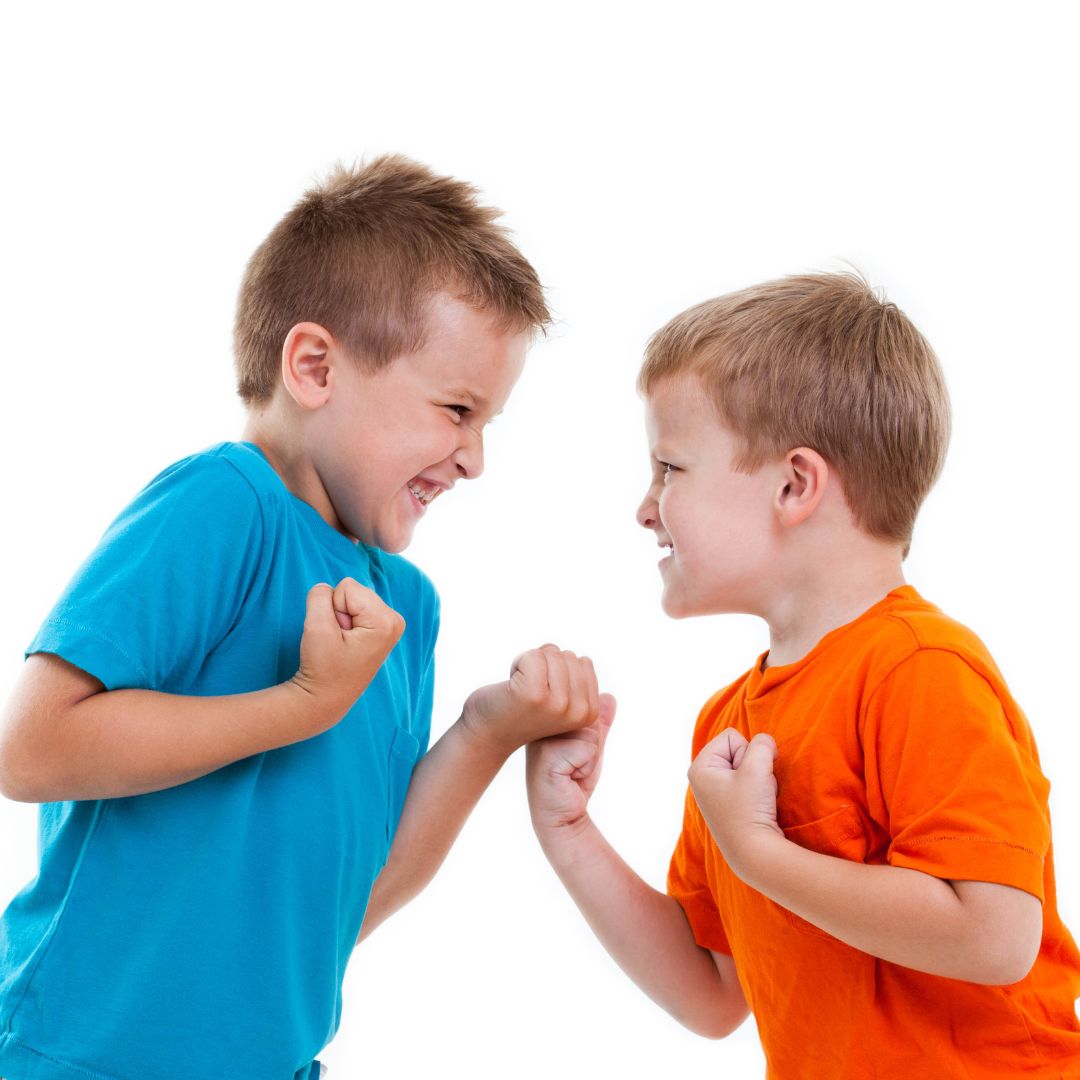
During rough play, children repeatedly experience moments like:
“That felt big—but I handled it.”
“I got knocked over and recovered.”
“I can stay engaged even when things feel intense.”
Over time, this builds what psychologists often call stress tolerance or adaptive resilience. The child begins developing an internal belief system that says:
“I can handle discomfort.”
“Big energy does not automatically mean danger.”
“I can feel powerful without becoming destructive.”
“I can recover after mistakes or overwhelm.”
Research around risky play and physical play also suggests that children who engage in appropriately challenging play often demonstrate:
greater confidence
lower anxiety
improved adaptability
stronger emotional coping skills
Why?
Because the nervous system learns through experience! Children develop resilience by repeatedly moving through challenges and discovering:
“I got through that. I adjusted. I recovered.”
This is one reason roughhousing can be especially beneficial for anxious, highly sensitive, or rigid children when done with emotional safety in place (and obviously physical safety). It provides an embodied experience of intensity without catastrophe.
And perhaps most importantly, roughhousing can strengthen a child’s confidence in the relationship itself:
“Even when things get big, we stay connected.”
That feeling can become part of a child’s internal blueprint for relationships later in life.
Children who repeatedly experience safe connection during moments of intensity begin to develop a nervous system expectation that:
conflict does not automatically mean abandonment
big emotions do not automatically destroy connection
repair is possible
emotional safety matters
These experiences help shape how children recognize connection, trust, boundaries, and emotional availability as they grow into adulthood.
As someone who has personally experienced relationships lacking emotional safety, this piece feels especially important to me.
When children are raised with consistent experiences of:
“Even when things feel big, we can stay connected safely,” they are more likely to recognize when relationships feel emotionally unsafe, emotionally inconsistent, or chronically disconnected later in life.
That awareness matters.
It can influence:
the standards they hold for relationships
the boundaries they feel empowered to set
the way they interpret repair, respect, and emotional presence
and the kinds of relationships they are willing to remain inside of
In many ways, healthy play, co-regulation, and emotional safety are not just shaping childhood.
They are shaping future relational expectations.
And for girls especially, given recent world events, for me there is something profoundly important about learning early that love and connection should still feel safe, respectful, and emotionally secure—even during moments of intensity.
👩👧 What about mothers and roughhousing?
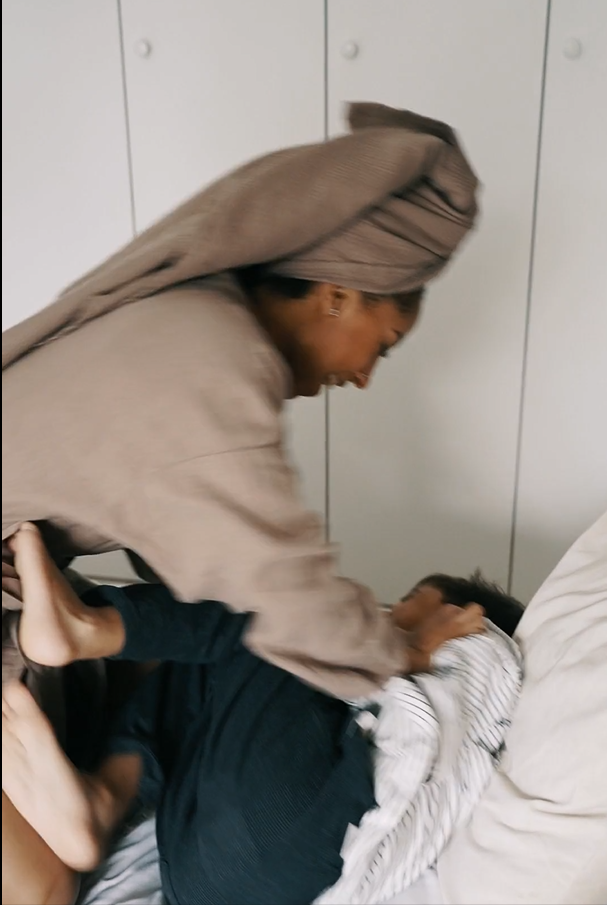
Mothers often bring unique strengths into this space:
a different level of emotional attunement and empathic awareness
offering verbal guidance during play
emphasis on connection and repair
For example:
“That got a bit too rough—let’s try again."
This combination is powerful: connection + boundary in real time.
It’s less about gender and more about nervous system capacity.
In practice:
Some caregivers naturally bring more intensity and unpredictability
Others bring more regulation and co-regulation
But these are tendencies, not rules.
With awareness, caregivers can learn to integrate both.
⚠️ When roughhousing stops being helpful
The benefits of rough play depend entirely on one condition: safety within connection.
Roughhousing becomes unhelpful when:
the adult is dysregulated (angry, reactive, or forceful)
the child cannot influence the play or “win” at times
boundaries like “stop” are ignored
the play escalates into real aggression
At that point, it is no longer regulation-building—it becomes overwhelming or confusing for the child’s nervous system.
So the question is not:
“Should we roughhouse?”
It is:
“Is this play regulated, reciprocal, and safe?”
The healthiest rough play lives in a very specific zone: Challenging, but not overwhelming.
In this space, your child experiences:
power without losing control
intensity without fear
excitement with safety
connection inside activation
💡 What healthy roughhousing can look like in real life
It doesn’t have to be complicated.
It might look like:
wrestling on the floor where your child sometimes “wins” or experiences some level of success
playful chasing games
pillow fights with clear boundaries
gentle pushing games where they feel resistance and strength
What matters most is not the activity—it’s the quality of interaction.
And just as important as the play itself is how you guide it in real time:
“Whoa, that got a bit wild—pause. Let’s reset.”
This kind of language teaches children something deeper than the game itself: awareness, reflection and regulation in the middle of activation.
🧠 The bottom line
Roughhousing is not just play. It supports nervous system "training", boundary awareness, confidence building, relational learning and emotional learning practice. It is one of the most natural, embodied ways children learn how to handle big feelings, big energy, and real-world interaction.
And for mothers especially, your ability to bring both attunement and structure into this space can make roughhousing not just safe—but deeply regulating and growth-enhancing.
CLICK HERE TO GET THE FREE HEALTHY ROUGHHOUSING CHECKLIST AND GUIDE
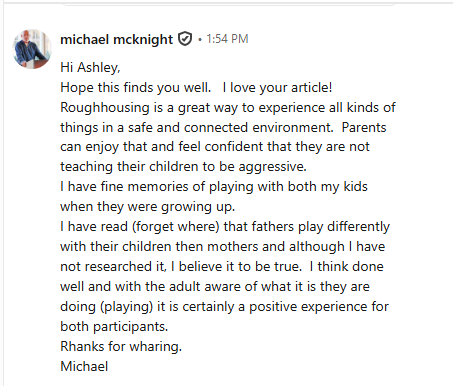
⬆️⬆️ Feedback from Mr. Michael McKnight; an adjunct educator at Stockten University with experience in navigating students who were challenged with emotional regulation.**Disclaimer** Any feedback from colleagues and professionals are in no way proof of endorsement of the work Ashley Anjlien Kumar does, just pure feedback 😁
Got Questions, Concerns or need to connect further? Reach out [email protected]
WHO IS THE

They say that our kids don’t come with a manual when they’re born…
Pssst! I’ve got a secret to share with you! I've got THE MANUAL!

As a Self-Esteem and Self-Confidence Coach for Kids and Certified Master Parenting Coach, I help families create cohesive, connected and expressive teams where the focus is to help kids gain sensational self-confidence and soaring self-esteem, while helping parents overcome hurdles that prevent them from achieving the supportive and peaceful family system they desire.
For kids, I use a 6 step system rooted in story-telling and multi-sensory learning to go from disempowered, disengaged and unmotivated to self-empowered, self-connected and self-motivated.
With parents, I have a unique and very comprehensive 14 step approach that allows us to explore parenting patterns that play a role in the challenges kids and families experience - which impact overall well-being in addition to academics and school performance.
The goal is to provide information, awareness, strategies, and develop skills so that parents can grow into conscious, confident and empowered family leaders.
All the information presented in the programs are evidence-based, researched and involve the application of modern neuroscience, nervous-system science, positive psychology, and other studies around child-brain development and human sciences. Often materials lean on experts in the fields such as Dr. Dan Siegal, Dr. Peter Levine, Dr. Rocio Zunini and many others.
For a FREE Parent Consult (and to learn about this "Manual" that I have), or for a FREE Kids Confidence Consult, please reach out via email to [email protected]
Yours In Confidence,
Ashley Anjlien Kumar, The Confidence Coach for Kids & Parents
