
RECLAIM YOUR ROLE AS SCREEN TIME LEADER
It's Time to Reclaim Your Role as Screen Time Leader (Here's How)
Written by Ashley Anjlien Kumar, Master Certified Parenting Coach, Certified Kids Self-Esteem and Confidence Coach, Somatic Trauma Therapy Practitioner
You know that moment when you tell your child their screen time is up, and suddenly you're in a battle you never wanted to fight? The pleading, the negotiations, the meltdown when you stand firm?
Here's what nobody tells you: this isn't a parenting failure on your part.
Tech companies have hired specialists in human behavior and brain chemistry to make their platforms as irresistible as possible—to both you and your children - this includes gaming platforms. Every app and platform is deliberately built to override willpower and "good intentions."
Algorithms vs. Parents: The Battle You Didn't Know You Were Fighting

Some experts are suggesting to struggling families that instead of just restrictions, to start with education.
If you've got teenagers, watch documentaries that expose how digital platforms actually operate— like The Social Dilemma, Screenagers, Childhood 2.0, Screened Out, and The Great Hack.
These films pull back the curtain on notification timing, algorithmic manipulation, reward loops designed to trigger dopamine, and massive data collection operations that profit from prolonged engagement.
(See end of the article for viewing age guidance - some of these are not suitable for young children.)
After watching some of these films, some teens started viewing their phones with suspicion. They realized their attention wasn't just valued—it was the commodity being bought and sold between big tech. This is what modern parental leadership looks like: helping children recognize what's invisible to them.
Some kids started setting their own limits after viewing some of the films.
And although that sounds nice, parents still need to be the leaders on this front because even the most well-intentioned adult will struggle with impulse control, so expecting your children under the age of 25 (age 25 is when approximately the human brain comes into "maturation") to control their impulses perfectly is unreasonable...
But parents can't guide others through territory they don't understand themselves. And right now, most adults are just as lost in addictive digital loops as their children—scrolling mindlessly, checking notifications compulsively, unable to resist the pull.
The platforms designed it this way. Your struggle is their business model.
These aren't neutral communication tools. They're carefully engineered experiences built on psychological research spanning decades. Researchers from Oxford University have documented that outcomes depend heavily on context—when screens are used, what's on them, and critically, what real-world activities they're replacing.
The Biological Reality: What Screens Do to Growing Brains
Let's talk specifics about what's happening inside your child's developing brain.

Global health authorities warn against more than 60 minutes of passive screen viewing daily for children between ages two and four. Why such a specific limit? Because young brains develop through three non-negotiable foundations: physical movement, adequate sleep, and face-to-face human interaction.
When digital devices crowd out these essentials, the first casualties are attention capacity, emotional self-regulation, and healthy sleep patterns.
Evening screen exposure triggers a cascade of biological disruptions. Studies demonstrate that blue light from devices suppresses melatonin production and pushes back the body's internal clock—the circadian rhythm that regulates the sleep-wake cycle. Additional research from Harvard's medical school documented how reading on light-emitting screens before bed extends the time it takes to fall asleep and reduces time spent in REM sleep—the deep, restorative phase.
Translation? Children who can't wind down when bedtime arrives, who sleep fewer hours than their bodies require, and who wake up already depleted of the self-control and emotional balance they'll need all day. These aren't minor inconveniences—they compound daily, reshaping behavior, learning capacity, and psychological wellbeing.
The Invisible Loss: What Kids Miss While Staring at Screens
Digital devices have fundamentally changed how children acquire the social and emotional capacities humans have depended on for thousands of years.
In-person interaction among young people has declined dramatically, and the consequences surface everywhere: difficulty maintaining eye contact, trouble interpreting emotions, inability to navigate disagreements, low tolerance for unstimulating moments (boredom resulting in big, sometimes aggressive behaviors), and struggles forming authentic friendships.
These lacking skills aren't just trivial social niceties. They're foundational competencies that determine empathy, communication effectiveness, leadership capability, and emotional strength.
When children conduct most of their social lives through screens, they bypass thousands of tiny interactions that train developing brains: awkward silences, subtle facial expressions, shifts in voice tone, the challenging work of repairing relationships after conflict. These capacities don't develop through digital interfaces. They emerge through direct human contact.
UCLA scientists studied sixth-graders attending a five-day outdoor camp where screens were prohibited. Compared to peers who maintained regular media consumption, the campers showed significant improvement in recognizing nonverbal emotional signals—reading facial expressions and interpreting other unspoken cues.(1)
Here's the good news if we collectively act swiftly and consciously: SKILLS CAN BE REBUILT. Simple shifts—meals without phones present, unstructured screen-free playtime with friends, consistent daily time outdoors, encouraging children to resolve conflicts face-to-face and coaching them with the skills to do so —can restore what's disappearing from childhood right now....
How Families Accidentally Train Kids to Need Screens
Child gets bored. Parent feels exhausted or overwhelmed, or has become conditioned to not see any other options. The screen creates a "false" sense of peace when handed to a child...
Another layer under all this is that any trauma a parent has accumulated, can cause them to experience anxiety and discomfort when they witness their own children having 'big emotions' and subsequently give in to the screen demands... (this is a nuanced topic, but occurs far more regularly than you might think...)
The child's brain takes note of this sequence immediately. Devices deliver rapid stimulation—vivid colors, constant sound, quick movement. By comparison, regular life experiences feel sluggish, unbearably slow, etc. Physical toys start to lack luster. Even talking feels dissatisfying.
So when a child experiences boredom again, their brain recalls the experience it had with screens ("feel good"). So the request comes again. And again.
If the screen has become the family's default tool for handling boredom and managing stress, the family is headed down a path of more future struggles that may "cost" more than it's worth for temporary "peace."
When brains adapt to continuous passive stimulation, ordinary activities like reading books, making art, or quiet play demand more cognitive effort. The brain adjusts to expect faster rewards. This creates huge shifts in critical life skills like patience, attentive listening, frustration tolerance and so much more!
When families stop using screens as the automatic response to a child's discomfort, or even the parent's discomfort, children start to gradually rediscover their own creativity and problem-solving skills.
Thoughtful Screen Consumption...
You're battling systems designed by big-tech teams holding advanced knowledge in persuasive technology, variable reward timing, and behavioral conditioning. Every notification alert, every auto-advance feature, every endless scroll exists for one singular purpose: keeping users engaged longer than they planned to be.
But it's not just screens and the platforms themselves, but also the context of when and how they are consumed, timing of use, and what activities screens are replacing. Parents need to get REALLY mindful of what they are modelling to their children and children who happen to be around.
The scene at the restaurant stays with me.
A mother and her toddler, maybe two or three years old, waiting for their food. The mom had handed her daughter a phone with a show playing, but the little girl wasn't that interested. She kept standing up, looking around, clearly wanting to engage with her mother—to talk about what she was seeing, to connect.
Each time, the mother gently guided the phone back in front of her daughter's face.
I know she meant well. She was trying to keep her daughter occupied. But watching this pattern repeat itself was heartbreaking. The child did want to be "occupied" but with human connection, not a digital device. I could see the neural pathways being shaped, the opportunities being missed, the message being sent: the screen is the solution - even when you're curious, even when you're looking for connection.
I see this everywhere now. At my kids' extracurricular activities, rows of parents with heads down, scrolling, while their children glance back searching for eye contact that never comes. And yes, I'm slightly hesitant to admit this to you reader, but I feel sick to my stomach every time.
Kids don't need phones in hand on their walk home from school! They need to thoughtfully calibrate their day, engage in nature and feel the wind on their skin (which helps them connect to their body and notice sensory systems, and build the skill of interoception) plan their after school snack, connect with other humans, and make thoughtful choices (executive functioning...). So we need to ask ourselves: Will we lead them back to their bodies, their world, and their humanity—or let the algorithm control them?
Thoughtful screen-time structure, consistent routines, and purposeful boundaries matter infinitely.
Reclaiming Leadership: 5 Practical Strategies
If personal willpower won't fix this, what will?

Leadership addresses root causes, not just surface symptoms.
Here are five concrete approaches to rebuild authority in digital spaces:
1. Educate Yourself First, Then Bring Your Kids Along
You can't lead in territory you haven't explored. Choose one documentary from the earlier list—The Social Dilemma or Screenagers work well as starting points. Learn how algorithmic systems function.
If your child is old enough (see age guideline at the end of this article), then watch together. Let them see how platforms track user behavior, how notification timing is calculated for maximum interruption, how companies profit from extended scrolling sessions. You might also find books on topic for younger children. I myself, as a Kids Resilience Coach have created stories and full complete learning modules on this topic to coach children in group and one-on-one settings.
When children grasp that they're the product being sold rather than the customer being served, their relationship with technology can start to shift. You might also talk about the latest research on grey matter and what happens to grey matter in the brain because of screen time, and how it can impair emotional regulation and decision-making in the long-term. Ask them what they truly want...?!
(See end of the article for a list of Grey-Matter related research and how screentime affects the brain including regulation skills, empathy and language skills...!) (2)
2. Build Tech-Free Zones
Designated screen-free times work. Device-free bedrooms work. Reliable and consistent shutdown times work.
The objective is protecting executive function development, healthy sleep patterns, and tolerance for activities requiring sustained effort thereby building resilience skills, while still allowing shared family entertainment.
Establish device-free family meals (yes, including yours). Set up a central charging station outside bedrooms where all devices spend the night. For families facing severe screen dependency, devices may need to be stored in a locked location with parental access only until the child develops more impulse control as they grow (and maybe some adults would benefit from this too!).
Screens down, chins up.
Clear structure reduces power struggles. Predictable routines minimize conflict. Thoughtful limits protect developing brains.
3. Model the Behavior You're Asking For
Your children observe you more carefully than you might realize.
If you check messages during conversations, scroll at the dinner table, or can't watch a movie without glancing at notifications, you're teaching them that screens take precedence over people.
Start small: place your phone in a different room during family time. Don't check it while driving. Make eye contact when your child speaks to you.
Leadership is demonstrated through actions, not just spoken boundaries.
4. Replace Screen Time With Something Genuinely Better
Telling children to stop using devices without offering alternatives is like removing crutches without rehabilitating someone to walk.
What does your family do instead?
Cook meals together
Play board games
Take walks
Build or create something
Do puzzles, word searches, read books, or crosswords.
Have genuine conversations - use tools like the conversation card games or "Would you Rather" games, to get started if it's currently feeling too difficult.
The specific activity matters less than establishing the pattern: authentic connection beats digital simulation in the long term and creates lasting skills...
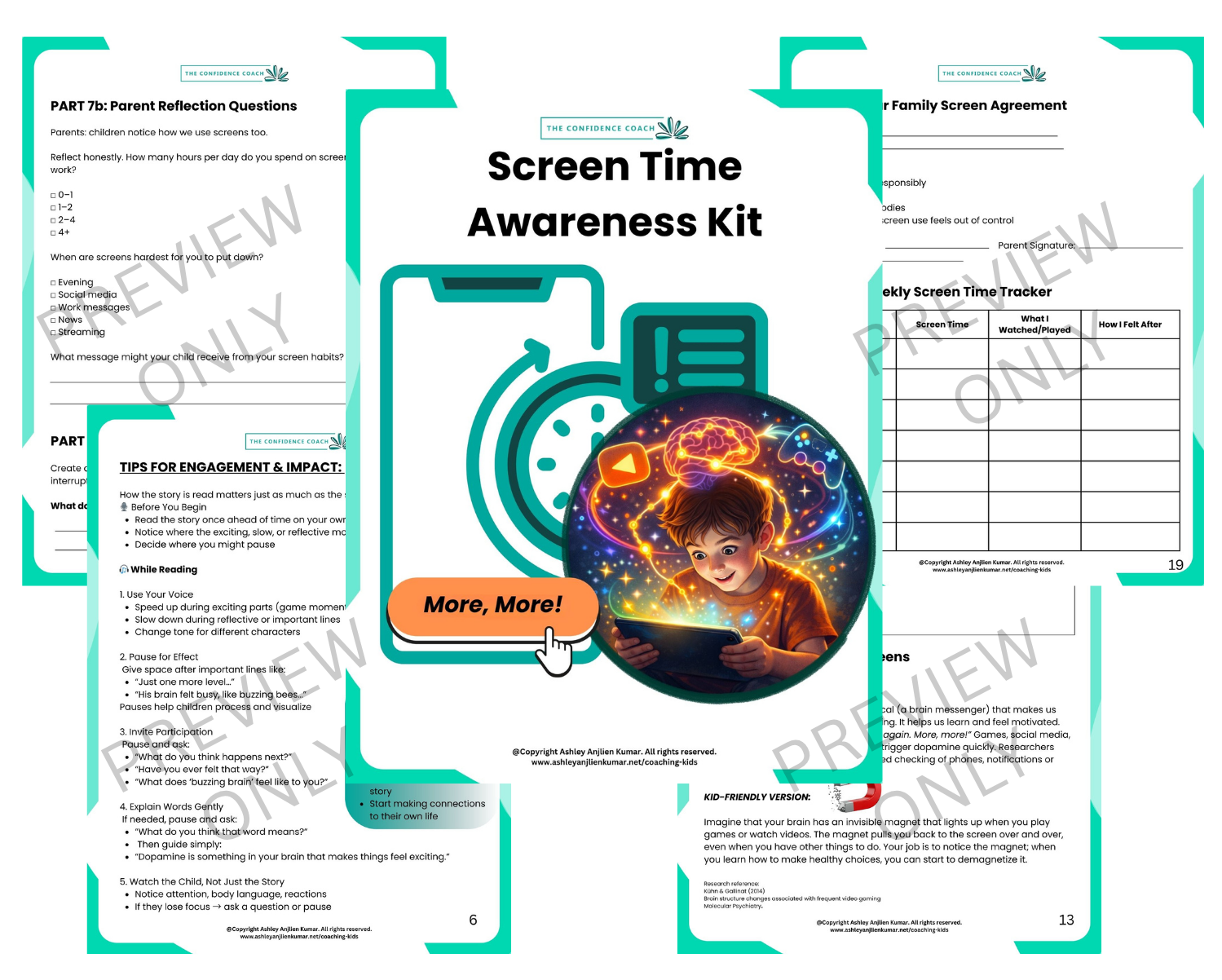
5. Use the Screentime Awareness Kit
I've developed a free resource specifically for children ages 6-11 that helps them understand what's occurring in their own brains during screen use. As a children's Self-Esteem Coach, I use the Story-Method of coaching and have included a story to set the tone.
The Kit includes:
The story "Arjun Learns About the Screen Secret:The Invisible “More, More!” Button."
Reflection questions helping kids notice their own behavioral patterns
Age-appropriate explanations of dopamine and reward pathways (some of it sounds complicated, but easy metaphors are offered to support understanding; and don't shy away from "big concepts". I've been coaching kids as young as age 4 since 2018 and have 2 kids of my own - they can understand big concepts if you help them break down the concept in developmentally appropriate ways).
A family discussion guide
Family Screen Time Agreement & Screen Time Tracker + MORE!
When children develop awareness of how they're being manipulated, they begin making wiser choices independently. Your role shifts from enforcer to guide. Scroll down to the end to request access to the Free Screen Time Awareness Kit.
What Changes When You Take This Seriously
If parents don't actively guide their children through digital environments, those environments will shape their children instead.
My goal isn't fearmongering. Researchers emphasize that children require face-to-face interaction to develop emotional intelligence—the ability to understand what others are feeling. These capacities don't develop passively—they require practice, repetition, and human proximity.
Currently, children are developing in environments where screens significantly shape how they think, behave, and understand the world. The effects will accumulate over time. You can look the other way if you'd like, but you may not like the results in ten years if do that...
Brain research also offers genuine hope: brains remain adaptable, especially young ones.
The question isn't whether change is achievable. It's whether you're prepared to lead it.
The Path Forward
Most parents didn't grow up in an era where children could access the entire internet from their pockets. You're navigating completely new territory, using parenting approaches designed for a pre-digital world.
That gap isn't your fault. But how you respond now is your responsibility. In fact I might even say it's our collective responsibility - my kids are watching your kids, and vice versa... your kids are watching other parents, etc.
Healthy boundaries, intelligent screen practices, and intentional parenting can protect your child's focus, confidence, and emotional development. But it begins with you stepping into empowered, conscious leadership.
Here's what that looks like practically:
Understand the systems you're dealing with
Establish clear, consistent boundaries
Model the behavior you wish to see
Provide healthier alternatives and lead the way in this...
Equip your kids to think critically about their own patterns
Screens down, chins up.
And you don't need to navigate this alone.
Ready to Start?
Download the free Screentime Awareness Kit designed specifically for families who want to help their kids understand what's really happening when they're on devices.
This isn't another rule list to enforce. It's a conversation starter that empowers your child to develop their own awareness.
[Click here to request your free Screentime Awareness Kit]
Inside, you'll find age-appropriate explanations, reflection exercises, and family discussion guides that make this topic accessible and actionable.
Because the most effective screen time limits aren't the ones you impose. They're the ones your kids choose for themselves once they understand what's at stake.
Let's help them see clearly. Together.
Yours, In Confidence
Ashley Anjlien Kumar, The Confidence Coach for Kids & Parents
____________________________________________________________________
Viewing age guidance for family viewing:
Screenagers – Appropriate for ages 10+ when watched with parents; specifically designed to help families start conversations about healthy screen use
The Social Dilemma – Recommended for ages 12-13+ due to themes around social media manipulation, teen mental health, self-harm, and suicide
Screened Out – Generally suitable for ages 13+, includes discussions about digital addiction, social media pressure, and mental health
Childhood 2.0 – Best for ages 13+ with parental guidance; explores cyberbullying, online predators, pornography exposure, and the realities of growing up online
The Great Hack – Recommended for ages 14+, focuses on data privacy, political manipulation, and the Cambridge Analytica scandal
_______________________________________________________________________
(1) https://www.sciencedirect.com/science/article/pii/S0747563214003227?via%3Dihub
(2) KEY RESEARCH STUDIES:
1. Cincinnati Children's Hospital - Preschoolers (2022)
Finding: Higher screen time associated with lower cortical thickness (thinner grey matter) and lower sulcal depth in multiple brain areas including visual processing regions and areas involved in social cognition, reasoning, and empathy WHO
Link: https://www.nature.com/articles/s41598-022-20922-0
Published in Scientific Reports (2022)
2. JAMA Pediatrics Study - White Matter Integrity (2019)
Finding: Children with more screen time showed lower structural integrity of white matter tracts supporting language and literacy skills, plus lower scores on language measures Children's Health
Links:
https://www.sciencedaily.com/releases/2019/11/191104112918.htm
Original study: https://jamanetwork.com/journals/jamapediatrics/fullarticle/2754101
3. ABCD Study - Adolescents (Multiple Publications)
Finding: Kids with higher screen use had thinner cortex in visual areas and in areas involved with social cognition, reasoning, and empathy—areas that should be thickening at that age, not thinning PubMed Central
Interview with lead researcher: https://beingpatient.com/screen-time-john-hutton/
4. Japanese Cohort - Long-term Study (2024)
Finding: Internet usage decreased grey matter volume in extensive brain regions ScienceDirect
Link: https://www.nature.com/articles/s41598-024-63566-y
5. Infant Screen Time - Singapore Study (2025)
Finding: High screen exposure before age two linked to accelerated brain maturation, premature specialization in visual processing networks, slower decision-making at age 8, and increased anxiety by age 13 UCLA
Link: https://neurosciencenews.com/anxiety-neurodevelopment-screen-time-30079/
6. ADHD & Screen Time - Brain Structure Mediation (2025)
Finding: Brain structural changes mediate the relationship between screen time and ADHD symptom development
Link: https://www.nature.com/articles/s41398-025-03672-1
7. Comprehensive Review (2025)
Finding: Research on screen time effects on brain development, particularly regarding neuroplasticity and gray matter, has grown significantly, with evidence of impacts on attention, cognitive development, and brain structure Education WeekUcla
