
Kids are Respectful to Friends but Scream at You?
Why do my pre-teen kids speak respectfully at school and with their friends, but scream at me - their parent - at home?
"I don't get it - she's respectful to her grandparents, her friends and teachers, and I feel like I get the worst of her at home," said an exhuasted overwhelmed mother of three to me during a parent coaching session.
It's not easy. It's hella triggering. I get it, parents.
There is major pushback from society right now around the idea of "gentle parenting." And there is a VERY particular reason I never really used the term.
Today's modern world where over-stimulation and dysregualtion are rampant, parenting kids doesn't look or feel gentle.
Instead, we need firm, steady, warm and nurturing parenting - and I have always called it Conscious Parenting. It's about understanding what's "beneath the surface" of the iceberg, interrupting subconscious patterns, and flowing in our parenting with conscious awareness and somatic self-support.
Here's my process for this:
#1) Understand - look beneath the behaviour.
#2) Connect to your feelings, needs and values.
#3) Communicate how you'd want your child to communicate with you...
#4) Hold your boundary, and avoid power-struggles and over-explanining.
_______________________________________________________________________
#1) Understand:
Why do pre-teen kids act healthily outside of home, and then give us the growls and screams just because we asked them to pick up their socks?
Let me be clear: I am by no means justifying their behaviour when I'm asking us to understand their behaviour and what lies underneath. But understanding the behaviour beyond what you see visibily, is the critical first step to avoid creating rupture and more conflict in your family systems.
So answering the the question above, it's because home and the outside world are asking very different things of a pre-teen's developing brain and social system.
A child can be capable of speaking respectfully in the general sense —and still sound curt, dismissive, or rude at home while becoming overly agreeable, quiet, or hesitant around peers. Those behaviours can actually come from the same developmental process: figuring out “How much of myself is safe to show here?”
At home: “I can let it all out here.”
Parents are usually the safest relationship in a child's world. That means the child may:
drop the social filter they've been using all day
release frustration that has accumulated elsewhere
experiment with autonomy and authority
naturally assume, “Mom/Dad will still love me if I show that I'm annoyed.”
push boundaries because they're testing where their growing independence fits
use fewer social niceties because they don't feel they have to "perform"
So the curt “Fine.” “Whatever.” “I know.” “Can you just stop?” isn't necessarily evidence that the child doesn't respect their parent.
Sometimes it's actually the experience of safety + not-yet-developed communication skills and emotion regulation skills + a strong drive for independence.
That doesn't mean parents should say "yes" to disrespect. It means the response can be “I understand what is underneath this, and I'm still going to hold the boundary around how we speak to one another.”
At school or with friends: “I need to belong.”
Now the equation changes.
Around peers, belonging becomes enormously important during the pre-teen years. A child may become highly attuned to:
“What will they think of me?”
“Will they laugh?”
“Will they think I'm bossy?”
“Will I look weird?”
“Will they stop inviting me?”
So a child who is quite outspoken at home may become tentative, agreeable, or overly polite around peers.
And this is where something interesting happens:
They may confuse confidence with social risk. Especially on a subconscious level.
If they've learned that being direct gets interpreted as:
bossy
mean
aggressive
“full of yourself”
argumentative
attention-seeking
then they may conclude:
“If I speak confidently, people won't like me.”
So instead of saying:
“I don't want to do that.”
they might say:
“Um… I guess that's okay…”
Instead of:
“That's not funny to me.”
they might laugh along.
Instead of:
“Please don't talk to me like that.”
they might stay quiet.
Instead of expressing a different opinion, they may simply go along with the group.
And there's a fascinating contradiction here
A child can be too blunt with people they feel completely safe with and too accommodating with people whose acceptance feels uncertain.
That's why I wouldn't frame this simply as:
“Your child needs to learn how to speak respectfully.”
They may need to learn something more nuanced:
“You can be direct without being disrespectful—and you can be respectful without shrinking yourself.”
That's a very important pre-teen skill.
It sits right in the middle between:
Aggressive:
“You're so stupid. Stop doing that.”
Passive:
“It's fine. Whatever you want.”
Assertive:
“I don't like that. Please stop.”
And children need actual practice distinguishing those three—not just a lecture about confidence.
There's also a developmental piece
Pre-teens are simultaneously developing:
a stronger sense of identity
greater sensitivity to social evaluation
more sophisticated awareness of other people's perspectives
increasing independence from parents
more complex peer dynamics
still-developing impulse control and emotional regulation
So they're in this awkward developmental middle:
“I am understanding who I am,"
while also thinking:
“But what if everyone else thinks I'm weird?”
That tension can produce some very different versions of the same child depending on who they're with.
And it is one reason confidence-building isn't simply about getting a child to “speak up.” The deeper work is helping them develop an internal reference point:
“I can care what other people think without handing them the authority to decide what I say, do, or believe.”
That is a much more powerful foundation for pre-teen confidence.
For parents, I'd hold both sides at once:
At home:
“You are safe enough to be authentic and honest here. You are also responsible for how you communicate with people in your family. We are a family team.”
With peers:
“You can be authentic without abandoning yourself. You can be respectful, direct, AND clear.”
Now that you have some basic understanding, lets go back to the moment they scream at you.
#2) Connect to your feelings, needs and values.
You feel your neck, shoulders, jaw and fists clench as they scream something unsavoury at you.
A need is at stake. Feelings are in play....
I teach kids about "triggers." It's a high level concept that many adults aren't even clear about today, but I teach it in very kid-friendly ways. So first parents, you've got to understand and improve your self-awareness about what triggers you, and then you've got to create a plan for managing that trigger.
In my parent coaching programs, I teach the A.R.M. method for dealing with "yucky" moments.
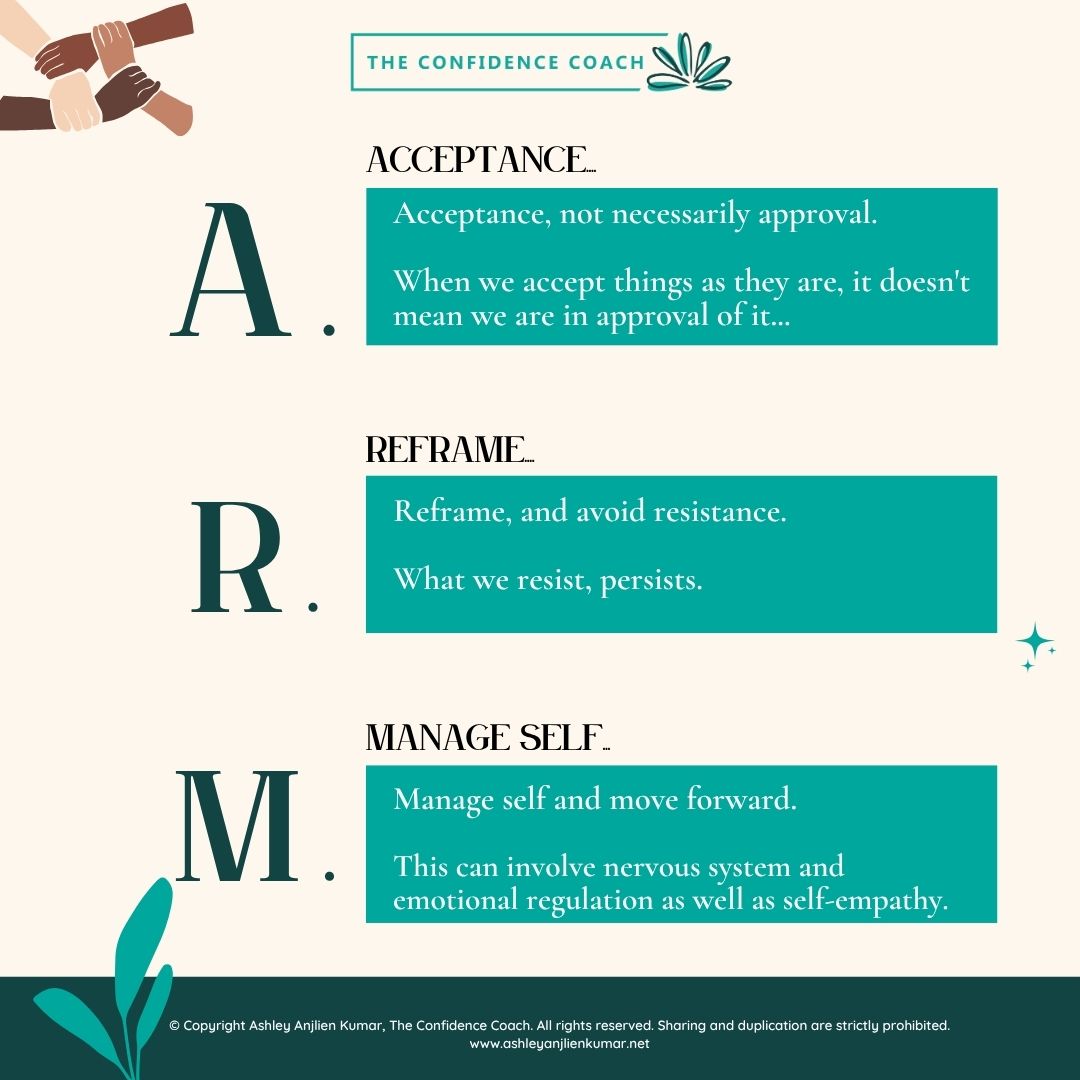
Our kid shouts at us when we've asked them to pick up a sock? Accept it - have you heard of "radical acceptance" as a therapeautic process? It's kind of like that in some ways... Accepting something DOES not mean you agree with it or like. Instead, it's accepting that "a thing" did happen:
"I accept that my child just screamed at me."
Yes, it's not fun to accept that, but whatever you resist persists. Acceptance isn't being "okay" with it; it's acknowledging that the "thing" did happen.
Reframe the situation from "My kid is obnoxious" to something more true; in my kids coaching programs I have a module for pre-teens where they create something called "The Telescope of Truth." It serves as a physical tool to represent examining a statement more closely to distinguish between wha was impulsively said, versus what is really observable. "My kid is shouting and upset" is more true in this case.
Now here's where the gentle parenting concept gets confused with permissive approaches. Just because you accept and reframe, doesn't mean you loosen a limit, boundary or rule. So right here is where many parents end up becoming permissive because they've spent so much time validating and acknowledging their child's emotions, while in-the-moment disconnected from their own needs and family values.
Becoming triggered is information! It means something important is being affected. Notice your feelings without acting on them right away - angry, shocked, saddened, anxious....etc. And remember it's okay to feel...
Manage self: use self-regulation tools that work for you. That's such a simple statement for me to make, but trust me, I spend a ton of time with parents helping them connect to their bodies to find what self-regulation tools actually work.
Now the arm method isn't a "step then next step" thing you do. They actually sort of happen very close together if not at the same time... I manage self (often using somatic self-support - discussed further below) while practicing acceptance and reframe to an observable truth.
Now as you do ARM, you also et used to recognizing your needs and values - this takes time and real visual tools. And yes, you guessed it by now, I teach kids about their core psycho-social-emotional needs and how to verbalize those needs.
I'd offer you the same here. You can get my Parent's Pocket Guide to Kids Needs + Kids Needs Cue Cards here and apply the learning to yourself first as a human (also consider the Kids Coping Skills Card Set); this is my head start offer for you to understand your own needs in the moment.
Your family values are the guiding principles through which you can determine and hold boundaries and limits.
For example, after going through a very specific values determination process (like I support my parent-clients to do), you then need to anchor your boundaries and family rules on these.
For example, if you find "Responsibilty" to be one of your top family values, then this serves as an anchor to why you go and back and discuss with your child about how they spoke to you or others in the family and how they are responsible for learning healthy communication. And of course, that you're here to help as their parent.
Now the problem is that many parents didn't actually learn healthy communication and dialogue for conflicnt management when they were kids, and no one gave them the parenting manual for that either. That's why having a professional Parenting Coach as part of your parenting "village" can be so life-changing.
When you understand your feelings and needs, you can give yourself Somatic Self-Support. Meet your body with bottom-up regulation tools and care, as you navigate the sticky situation. Somatic self-support takes practice. That's why I teach parents how to do this in my Somatic Self-Support Workshop for Overwhelmed Moms.
#3) Communicate how you'd want your child to communicate with you...
Can you think clearly when you're overwhelmed or really angry?
No, probably not that well, right? That's called "being in the red zone."
When we are more regulated, we can process dialogue and information better.
So would more words, directions and lectures help you feel better when you're upset or stressed?
No. So, should we really be doing that to our own kids...?
When your child screams at you, now is not the time to teach or coach on communication.
Instead, use fewer words, state your position, and move to the next step.
#4) Hold your boundary, and avoid power-struggles and over-explanining.
"I hear you screaming (observation). I'm not okay with this (boundary). I'm going outside for some air (manage self/regualte). The dirty socks will need to be taken care of at some point today (boundary)."
That's it. Don't explain the "why" in the moment. Justifying, arguing, defending or over-explaining each value, rule, limit or boundary does very little in the moment with a child who is dysregulated.
Conflict happens in families. What happens after conflict, when nervous systems have down-regulated, is important.
And this is where options open up for parents, and I teach the "B.A.L.A.N.C.E. CODE" method to find the "next step" in my parent coaching programs.
But here are some things that I need you to be certain of if you are on the path of Conscious Empowered Parenting:
1) Coming back after conflict to reinstate connection and clear up the stress pathways in the brain and body will pay long-term dividends for everyone in your family system; when you address "what happened" in healthy ways, it prevents stored stress and this reduces problematic behaviour in the furture.
2) In-the-moment the more you argue, justify or defend a boundary, rule or action you want your child to take, the more your child can "dig in their heels" because they don't percieve your instructions and guidance from a grounded state; they recieve it as a threat to their autonomy during a dysregulated state. That will backfire for everyone involved.
3) Don't let the boundary slip. Consistency matters. The socks get taken care of before the end of the day if you're rooted in your value of responsiblity.
After addressing the situation, and reinstating connection, there are various methods to support cooperation in children using Conscious Parenting principles - and I work on creating those concrete plans with parents in my parent coaching work.
To get individualized support, please book a FREE Parent Coaching Consultation today, and lets help you transform your parenting and family dyanmics.
P.S. Coming up in November 2026, we begin our inagrual cohort for the "Lotus Parenting Path" group coaching program for parents. It is the Beta testing phase of the program and we are offering a deeply reduced investement as we launch and tweak our processes. So book your FREE Parent Coaching consult today and we'll see if it's the right fit for you.