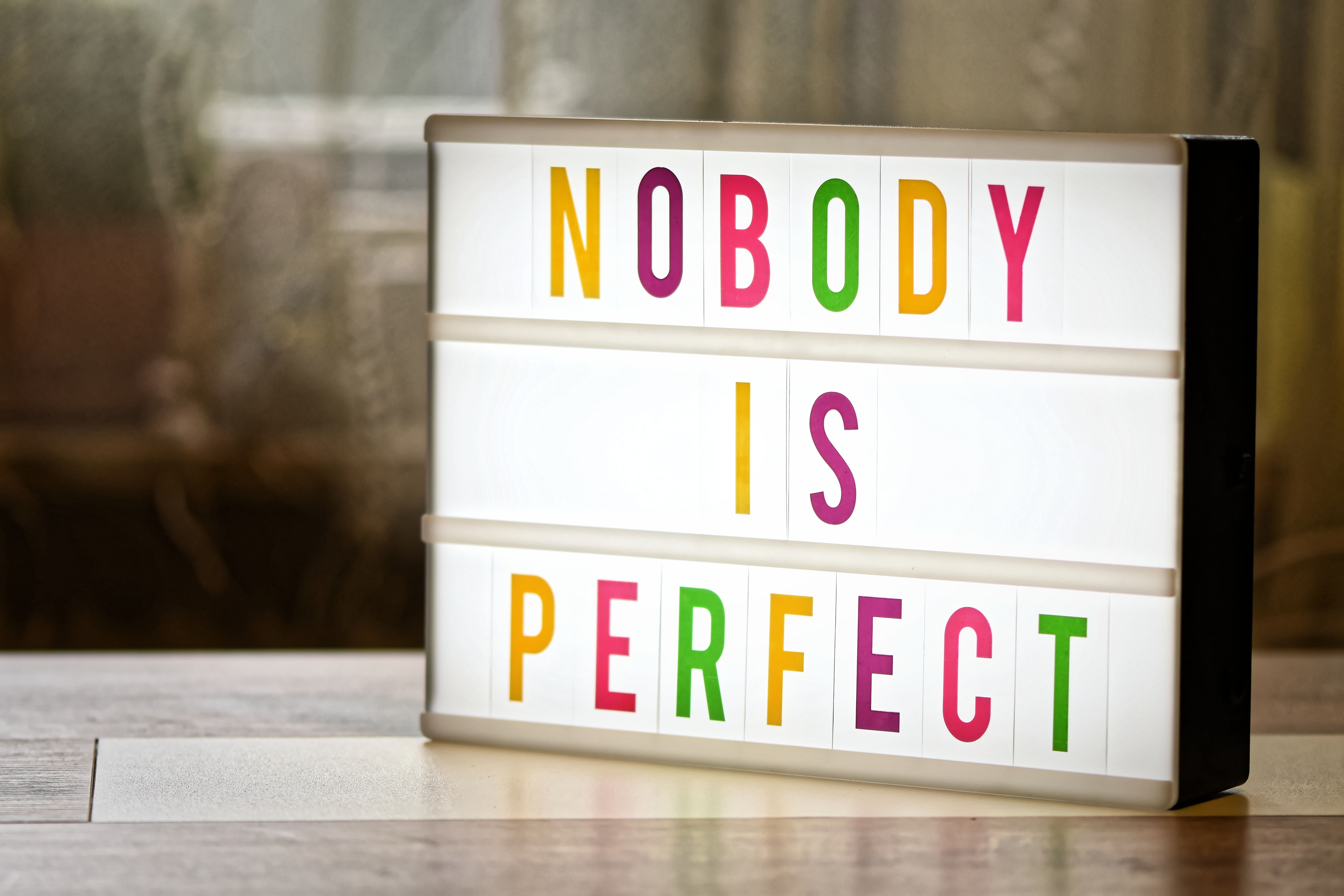
3 Ways to Reduce the Chances of Perfectionism Developing in Your Children
The Moment It Clicked
I was sitting in the rocking chair in my son's room, watching my kids pull the fresh sheets and blankets off his bed and pile them onto the floor to build forts, chairs, and a pretend campsite. I watched my own thoughts unfold.
Here's how it went:
"Agghh… clean sheets. Dirty floor. Not hygienic. They have to sleep in those! Distress, distress!"
Tightness in my chest, my jaw, the sides of my face — my amygdala kicking in.
Pause. Coping breath.
My mind then had a string of thoughts:
"It's just sheets, Ashley. It's not like they're rolling around in the dirt with them. Hmm, I wonder where my distress came from...— OH. That's my mom's voice."
My mother's dialogue had become my inner dialogue for most of my adult life. She talked about cleanliness everyday. In terms of our beds, not playing in our beds, and definitely not playing with our blankets (meant for sleeping) on the floor.
Early on in parenthood, I used to fuss over my son's blankie and my daughter's bunny — the ones they sleep with. It was an inherited belief: these things could get germy, dusty, dirty.
My mother was quick to react when I was a child, "Noo! No, no, no, no! Those are clean sheets — you cannot play with them on the dirty floor."

But my carpet isn't dirty.
Our house is generally clean. Sure, there's some dust, maybe a dust mite or two, a few hairs on the carpet that might land on the sheets — but honestly, whatever.
So I wondered: where does this mental pattern come from?
Here's the fascinating thing about asking ourselves questions. Our brain tries to find answers.
And then it clicked.
Where the Belief Came From
Our ancestral family is from India, and my mom was raised in Fiji — hot countries where people often slept outdoors or with windows open, and homes stayed open all day so air could move through. In congested towns and small rural huts, dust and dirt came with the territory, guaranteed to find their way inside daily. Of course beds were rolled up and sheets kept off the floor — we want to sleep on clean surfaces, after all. And we weren't an affluent lineage; new sheets and blankets weren't a luxury you replaced on a whim. Add in the older thread of yogic teachings on cleanliness and energetic care, and suddenly my mother's way of thinking made complete sense.
But also — according to my quick Google search, this isn't limited to one culture. Even colder-climate countries like England had strict "bedroom protocol": beds were for sleep and recovery from illness, not a play zone, and hygiene was a must. All of it makes sense, wherever it stems from.
Does it still apply today, in a world of modern ventilation and washing machines? I'd invite you to deduce that answer for yourself, based on your own values.
As for me: I live in a different country, with different ventilation, no dirt floors, no constant stream of visitors. We vacuum weekly. And I understand a lot more now about the child brain — how impulsive it is, how deeply wired for play.
So no — I don't need to fuss at my kids for playing with their sheets and blankets on my generally clean floor. It's okay. They're healthy. We're healthy. We're okay. This is safe.
Play, my dears. Play.
That whole experience lasted about two minutes in real time. Here's what it taught me.
1. Question the Origin of Inherited Habits
Examine the modern, current validity of the habits, phrases, and patterns you inherited.
Does it still apply? And if it doesn't, that's okay — it's worth getting curious about why we keep doing it, and why we ask our kids to do it too. What would it take to release an old belief that no longer serves us?
There's a story I've read and heard a few times, and I'm not sure of its origin, but it goes like this:
There was a favorite family recipe for a holiday ham that had been passed down through the generations. As the mother was making the ham for the umpteenth time, she taught her newly married daughter how to prepare it. She carefully cut both ends off the ham, set it in the pan, and added the secret combination of spices.
Her daughter, taking notes, asked, "Why do you cut off the ends?"
"Because that's how my mother taught me," the mother answered.
Later, the mother wondered the same thing herself, so she called her own mother. The grandmother said, "Because that's how my mother taught me." Curious now too, the grandmother called her elderly mother.
The great-grandmother laughed. "You don't need to cut off the ends! I only did that because my old oven was too small for a big pan."
⭐⭐⭐⭐⭐⭐
It's possible we've never questioned "the way it's always been done" simply because the pattern is so ingrained that questioning it doesn't even cross our minds to consider questioning it — until something prompts us to.
When kids absorb the message that there's one specific "right" way to do something, any deviation — any error, any imperfect result — becomes stressful. They start to deeply want it to be "just right." They want it right the first time. (I've seen this over and over — after 26 years of working with kids).
I remember my mother — who has strong perfectionist tendencies, ones I inherited from her — spending twenty minutes getting the pleats in her saree just right. I'd watch her stop and start over again, again, and again, even when we were already running late. All the while, her stress spilled onto us: "Hurry up, hurry up, hurry up!"
Years later, as an adult, I watched other women put on their sarees in five minutes flat, pleats far from perfect. They just went with it... That was such a relief to witness — and important for me to see.
2. Let your kids see you mess up. Say it out loud when you do.
Spending 21 days in the NICU with my daughter, learning to breastfeed, baring my postpartum body — round belly, exposed breasts, unwashed hair, clothes that didn't fit right after my C-section — in front of countless nurses and doctors, stripped away a lot of the shame I'd carried about my body since childhood. Shame I'd developed because of my childhood conditioning.
I was cared for by the nurses just as lovingly as anyone else, and my daughter received expert care. It taught me: I am worthy exactly as I am — belly, breasts, and all. There was so much grace in those hospital rooms. Thank goodness! That didn't instantly rewire my brain into new self-worth, but it started to break the pattern of body shame I'd grown up with, and made me acutely aware of it.
So, let them see your perfect imperfections. Let them know you falter — and when you do, practice self-compassion instead of self-judgment. Love yourself, imperfections and all, and let your kids witness that.
It's about breaking the patterns that no longer serve us or our children — patterns that, in some cases, may never have served anyone at all.

3. Notice perfectionist tendencies you might have.
I have been attempting to recover from perfectionism since my teen years. Gosh, without support it takes decades sometimes... There is absolutely no judgment here. Yet my offer to you is to start noticing your own tendencies now. Anxiety and perfectionism are strongly correlated. Perfectionism—especially the self-critical kind where people feel they have to meet others' expectations is consistently linked to anxiety because it keeps the nervous system on alert for failure or judgment, triggering similar threat responses (elevated cortisol, hypervigilance) seen in clinical anxiety.
Notice when you fuss over something not being just so — and notice whether that thing even bothers your child, or only you. Ask yourself: is it okay for this to be done another way, different from how you've always done it? Get curious about these patterns. Can you trace them back to their root?
(A gentle reminder: most of these patterns come from our own past conditioning. That means it isn't your fault.)
Once you bring coherence to your own patterns and habits, you can actually work with that awareness. For example:
Do you prefer your child get ready in a specific order — toilet, brush teeth, get dressed? What happens inside you if she changes clothes first, then uses the toilet, then brushes her teeth? Or eats breakfast first?
Do you expect your child put away their lunch bag as soon as they walk in from school, or complete homework in one uninterrupted sitting? Notice what happens in you if they don't. Is the preference about what actually serves your child — focus, follow-through, a sense of accomplishment — or is it about your own discomfort with things being out of sequence? A conscious parent can hold a clear expectation (homework gets done, responsibilities get met) while still asking: is this specific order the requirement, or is it just the version I'm used to?
Let's get curious.
If any of this stirred something for you — a pattern you've never questioned, a rule you've been enforcing without digging into the "why", I've helped parents uncover exactly these patterns, the ones quietly fueling parent-child dynamics in their homes, and I can help you do the same.
Reach out, and let's start unpacking it together.
Here's to growing more conscious, confident, and empowered as parents!
WHO IS THE CONFIDENCE COACH FOR KIDS & PARENTS?

They say that our kids don’t come with a manual when they’re born…
Pssst! I’ve got a secret to share with you! I've got THE MANUAL!
As a Self-Esteem and Self-Confidence Coach for Kids and Certified Master Parenting Coach, I help families create cohesive, connected and expressive teams where the focus is to help kids gain sensational self-confidence and soaring self-esteem, while helping parents overcome hurdles that prevent them from achieving the supportive and peaceful family system they desire.
For kids, I use a 6 step system rooted in story-telling and multi-sensory learning to go from disempowered, disengaged and unmotivated to self-empowered, self-connected and self-motivated.
With parents, I have a unique and very comprehensive 14 step approach that allows us to explore parenting patterns that play a role in the challenges kids and families experience - which impact overall well-being in addition to academics and school performance.The goal is to provide information, awareness, strategies, and develop skills so that parents can grow into conscious, confident and empowered family leaders.
All the information presented in the programs are evidence-based, researched and involve the application of modern neuroscience, nervous-system science, positive psychology, and other studies around child-brain development and human sciences. Often materials lean on experts in the fields such as Dr. Dan Siegel, Dr. Gabor Mate, and many others.
For a FREE Parent Consult (and to learn about this "Manual" that I have), or for a FREE Kids Confidence Consult, please reach out via email to [email protected]
Yours In Confidence,
Ashley Anjlien Kumar
The Confidence Coach for Kids & Parents